

Operation Process and Working Principle of Fully Automatic Pneumatic Conveying Lines
In industrial production, an efficient and reliable material conveying system is crucial for ensuring smooth production processes. Fully automatic pneumatic conveying lines, as an advanced material conveying technology, achieve continuous and contactless material transport through compressed air drive. This article will detail the operation process and working principle of fully automatic pneumatic conveying lines, helping readers fully understand how this technology enhances production efficiency and material handling capabilities.
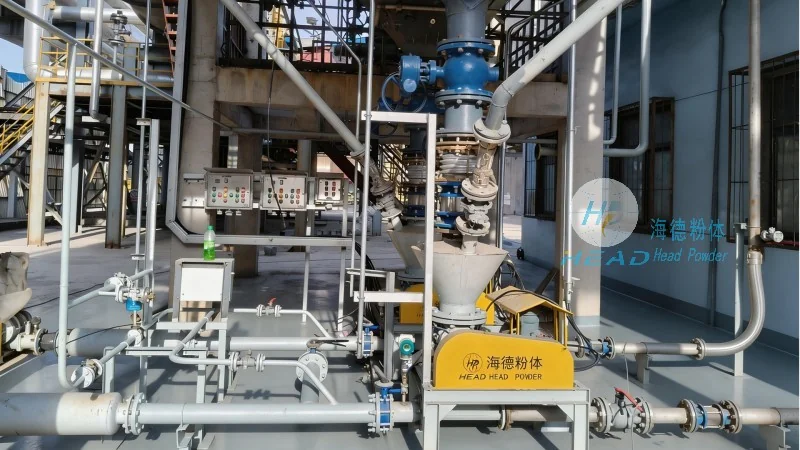
Company Background: Shandong HeadPowder Engineering Co., Ltd.
As a professional manufacturer in the industry, Shandong HeadPowder Engineering Co., Ltd. (referred to as HeadPowder) is committed to providing high-quality pneumatic conveying solutions to global customers. The company is located in Shandong Province, China, with an advanced R&D team and manufacturing facilities, focusing on the design, production, and optimization of pneumatic conveying equipment. HeadPowder has accumulated rich experience in the material conveying field through its technical strength and customer-oriented service philosophy, providing customized solutions for various industrial applications.
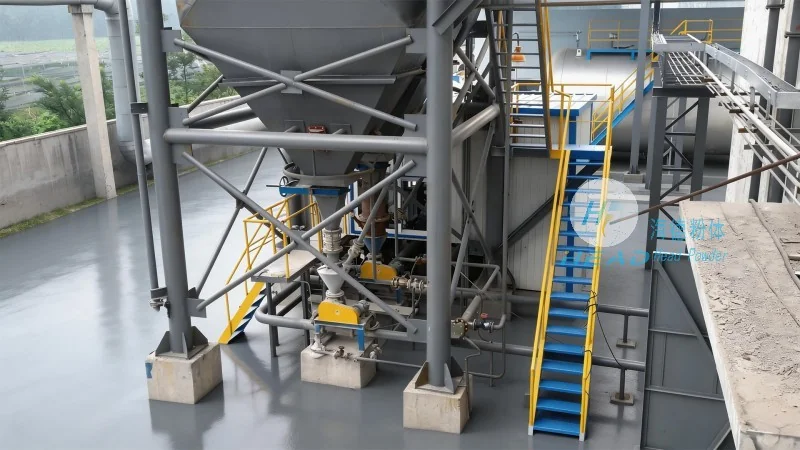
Operation Process of Fully Automatic Pneumatic Conveying Lines
The operation process of fully automatic pneumatic conveying lines typically includes several key steps: First, materials are loaded into a feeding device, such as a hopper or vibratory feeder, ensuring uniform entry into the conveying system. Subsequently, compressed air is generated by a blower or air compressor and enters the conveying pipeline. When materials enter the pipeline from the feeding device, compressed air suspends and pushes the material particles forward. During the conveying process, the material particles form a gas-solid two-phase flow in the pipeline, and the conveying speed and distance can be controlled by adjusting air pressure and flow. Upon reaching the destination, materials are separated from the pipeline by a discharge device (such as a cyclone separator or pneumatic unloader) and fall into the receiving container. The entire process achieves automated material transport, reducing manual intervention and improving production efficiency.
Working Principle of Fully Automatic Pneumatic Conveying Lines
The working principle of fully automatic pneumatic conveying lines is based on fluid mechanics and gas-solid two-phase flow theory. Its core is to suspend and transport material particles using the kinetic energy of compressed air. Specifically, when compressed air flows through the conveying pipeline at a sufficient speed, the dynamic pressure generated by the air flow overcomes the gravity of the material particles, carrying them in the airflow. During the conveying process, the mixture of material and air maintains a flowing state in the pipeline, and the conveying speed and distance can be controlled by adjusting air pressure and flow. Key components include the blower, feeding device, conveying pipeline, discharge device, and control system. The blower provides necessary air pressure and flow, the feeding device ensures uniform material entry, the conveying pipeline connects each part and guides material flow, the discharge device separates materials from the airflow, and the control system monitors and regulates the operation parameters of the entire system to ensure the stability and reliability of the conveying process.
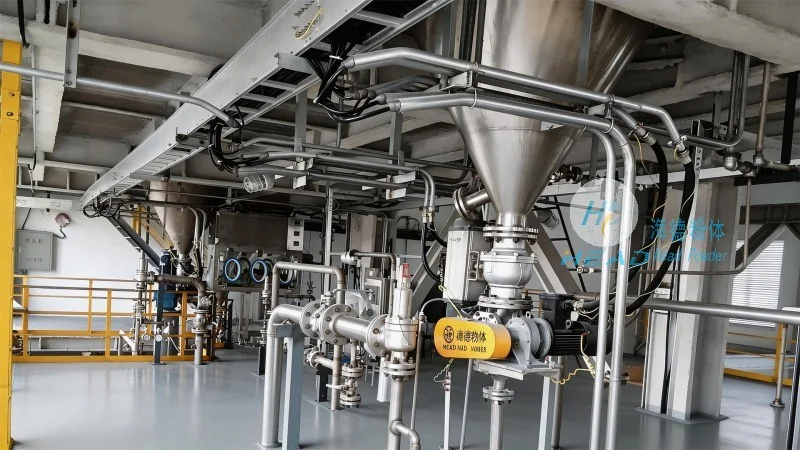
Application Advantages and Performance Characteristics
Compared with traditional conveying methods, fully automatic pneumatic conveying lines have numerous advantages. First, they achieve contactless material transport, avoiding friction and wear between materials and equipment, reducing material damage and contamination risks. Second, the system has a high degree of automation, reducing manual operation and improving production efficiency and safety. Additionally, pneumatic conveying lines can transport various materials, including powders, granules, and fine solids, suitable for industries such as food, chemical, pharmaceutical, and building materials. The conveying distance can cover short to long distances, and the conveying speed can be adjusted to meet different production needs. Fully automatic pneumatic conveying lines from HeadPowder also feature energy-saving and environmentally friendly characteristics, reducing energy consumption and greenhouse gas emissions through optimized air flow and pressure. These performance characteristics make fully automatic pneumatic conveying lines an indispensable material conveying equipment in modern industrial production.